
Deep Center Brings Critical Hope to the Southeast Conference on School Climate
Earlier this month Deep Center’s Director of Restorative Practices and Culture, Dr. Mel Kutner, co-presented at the 2025 Southeast Conference on School Climate and Culture (SeCSCC) with long-time collaborator Dr. Peggy Shannon-Baker of Georgia Southern University. This presentation brought a Savannah-rooted, justice-centered perspective to a regional stage—sharing how critical hope can guide educators in building truly restorative, culturally responsive school environments.
About the Conference
The Southeast Conference on School Climate and Culture (SeCSCC) is a two-and-a-half-day professional learning event that convenes hundreds of educators from across the region. Focused on research-based strategies to improve school climate, safety, and student well-being, the conference equips school administrators, counselors, and teachers with practical tools to enhance students’ mental, behavioral, and academic outcomes. With sessions spanning topics like trauma-informed practice, restorative discipline, and culturally affirming instruction, the event serves as a key hub for educational innovation and collaboration across the Southeast – and the nation. It was a natural fit for showcasing Deep’s groundbreaking Healing Schools Initiative (HSI) and community-based approach to educational equity.

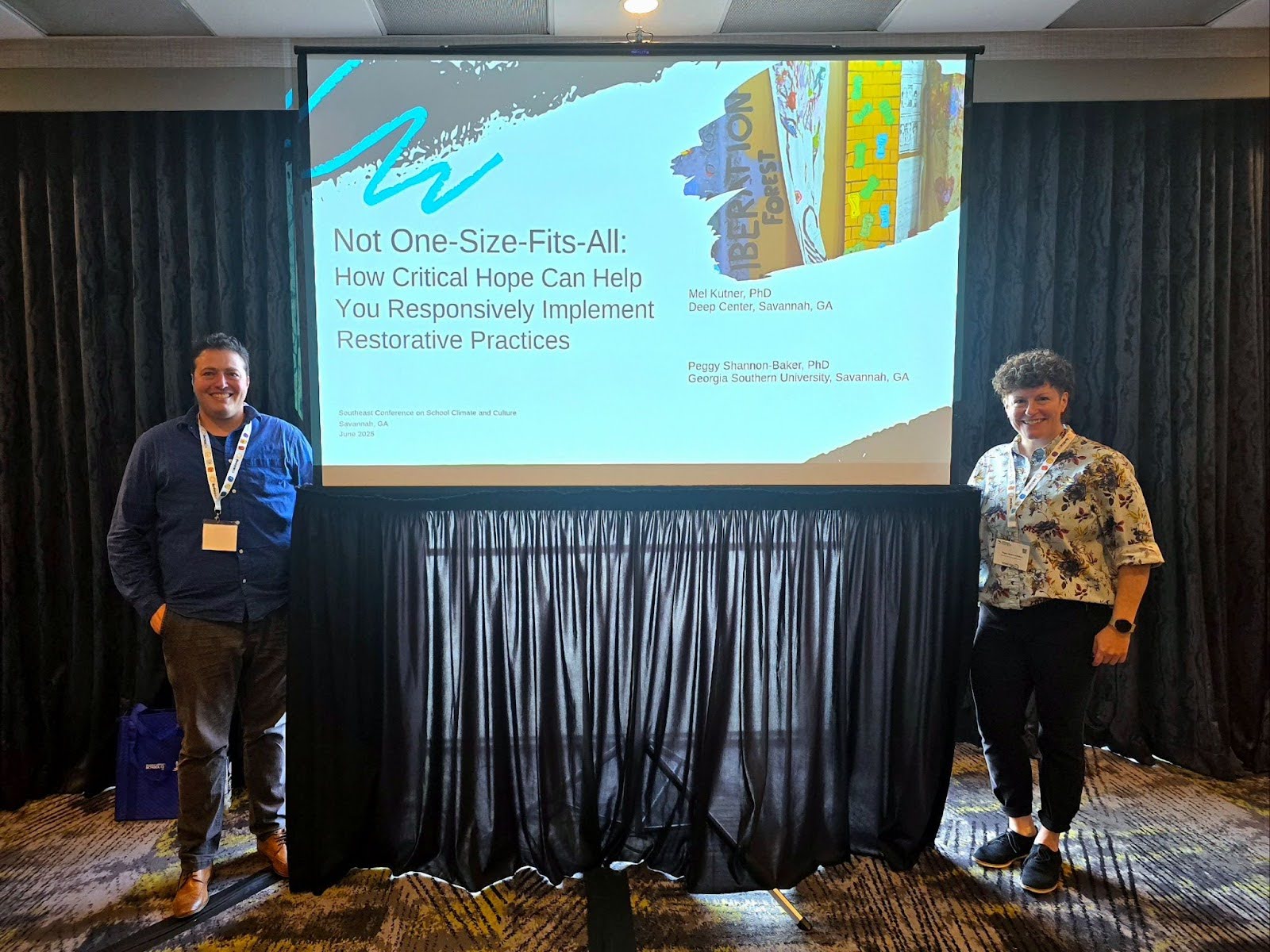
Drs. Mel Kutner (L) and Peggy Shannon-Baker (R) at the 2025 Southeast Conference on School Climate and Culture
Reimagining Restorative Practice with Critical Hope
In their session, Kutner and Shannon-Baker introduced critical hope not simply as a mindset, but as a robust, multidimensional framework rooted in research, practice, and iterative reflection. The five dimensions—Criticality, Self-Efficacy, Imagination, Action, and Community—were not created overnight. They emerged through a multi-year collaboration that combined extensive literature reviews, grounded school-based practice, and analysis of evidence-based measures.
This process helped ensure that the resulting framework was not only philosophically grounded, but practically useful in the diverse, real-world contexts where educators work.
The dimensions were refined over time as Deep Center and its university partners used them to assess and guide their professional learning programs, classroom practices, and school-level change efforts. What resulted was a framework both rigorous and flexible—something that could help educators move beyond one-size-fits-all approaches to restorative practice.
Here are the five dimensions of critical hope as defined in their work:
- Criticality involves the ability to analyze power structures, histories, and narratives. It is about how we “read the world,” reflect, and make sense of experiences.
- Self-Efficacy refers to having the skills and resilience to navigate conflict and advocate for change—even within constrained or resistant systems. It includes a grounded sense of what is within one’s control and how to act on it, without burning out.
- Imagination is the capacity to envision schools, relationships, and futures that don’t yet exist. This kind of future-facing creativity is essential for transforming harm, not merely returning to the status quo, and is informed by research and theory of arts-based education.
- Action emphasizes that hope is not passive. We all – educators, young people, and community members supporting change – must engage in consistent practices that resist despair and embody change, even in small, local ways. This can mean reframing how feedback is given, rethinking discipline practices, or using classroom structures to build shared power.
- Community recognizes that none of this work happens in isolation. Critical hope is relational and collective, affirming that belonging, dialogue, and intergenerational wisdom are all necessary for cultural and institutional transformation. Cultivating hope requires us to ask difficult questions, name truths, and stay connected to one another while doing so.
These five dimensions were presented not as a checklist, but as a map—something educators could use to reflect on where they are, where their schools are, and where they want to go.
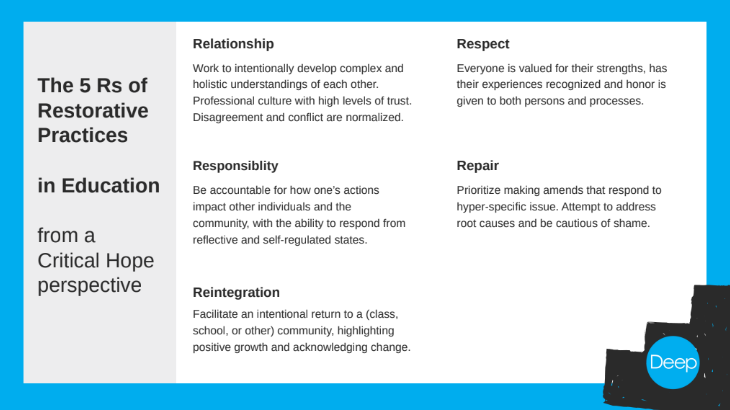
In the session, participants explored how each dimension of critical hope could align with the “5 Rs” of restorative practices: Relationship, Respect, Responsibility, Repair, and Reintegration. These “5 Rs” have served as a long-standing framework in restorative education, offering schools a way to rethink discipline and community-building by centering dignity, healing, and accountability.

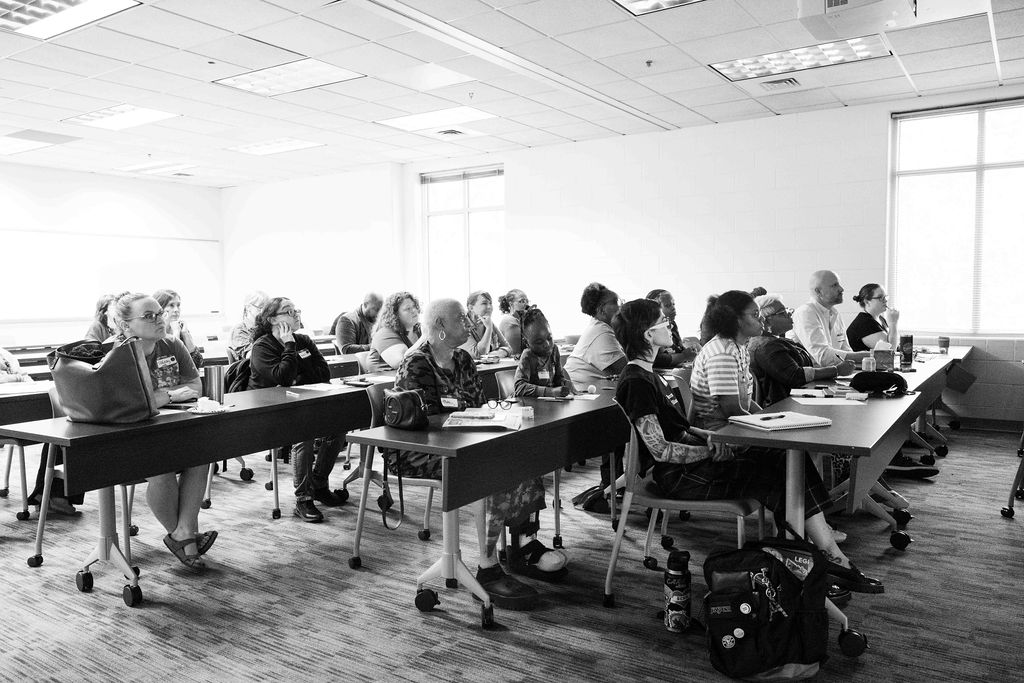
Through a gallery walk and small group activities, they shared and built ideas together—imagining how restorative education can be adapted to their unique communities, rather than copied wholesale.
Critical hope isn’t an “add-on” to restorative practice. It’s the soil that allows it to grow—anchoring educators not just in a vision of justice, but in the tools and relationships to make that vision real. For example, it can allow us to imagine how an apology between a student and teacher could become the start of a relationship transformation, rather than the end of a disciplinary exchange. Or it can be used to approach reintegration practices not as checklists but as acts of radical welcome— starting with small gestures like saying “We’re glad you’re back,” that can shift school culture.
From Framework to Practice: Deep’s Healing Schools Initiative
This work is not abstract for Deep. Over the past five years, Kutner has led the Healing Schools Initiative (HSI) in partnership with Savannah-Chatham County Public Schools. Through educator microgrants, world café-style community dialogues, restorative policy co-design, and affinity-based professional development, Deep has supported teachers, administrators, and students to build more connected and just school environments.
At Savannah High School, for instance, Deep collaborates with school leaders to facilitate a multi-generational Restorative Practices Committee of students and staff—a space for collaboratively defining what a “restorative culture” should look and feel like across the school day. That means building a shared understanding of discipline not as punishment, but as an opportunity to address underlying needs, foster student growth, and build stronger relationships among young people and with adults in a building.
A Shift Toward Responsiveness
As Kutner and Shannon-Baker emphasized throughout their session, creating Restorative School Cultures is not simply implementation—it’s adaptation. Implementation often means following a prescribed set of steps, strategies, or protocols, typically developed outside the school context. It assumes a framework is already complete and just needs to be installed. Adaptation, by contrast, is relational and dynamic. It requires working with a school’s existing culture—its histories, relationships, norms, and tensions—and modifying practices to fit that specific context. But it doesn’t stop there. Adaptation also means using restorative frameworks to shift school culture itself, expanding what’s possible. It goes both ways: reshaping the model to meet the school, and reshaping the school to embrace more healing-centered approaches.
Not every R of restorative practice maps neatly to every dimension of Critical Hope, or vice-versa, and that’s the point. Critical Hope allows us to work from within connections that are already alive in a school community or classroom and to see that Restorative School Climate and culture is not just about what practices you use. It’s about how you bring educators—and young people—into the process of shaping a culture together.
Deep Center: Building, Not Just Talking
Deep’s presence at the Southeast Conference reflects its growing role as both a local leader and national thought partner in restorative, healing-centered education. Through youth participatory action research, professional development for educators, and systemic policy work, Deep continues to model what it means to build school cultures that center dignity, belonging, and justice.
This work isn’t about fitting schools into pre-set boxes. It’s about forging and fortifying relationships that make up a school community by recognizing the full humanity of everyone – adults and young people. It’s about holding space for the challenges and joys of creating something more expansive, inclusive, and audacious together. That’s the real work of critical hope—and it’s already happening in Savannah and Chatham County, Georgia.
For those interested in bringing critical hope and restorative education into their schools, classrooms, or districts, Deep Center offers a range of supports—from tailored workshops to collaborative planning processes. Learn more at deepcenter.org, or reach out to Mel directly at mel@deepcenter.org.